
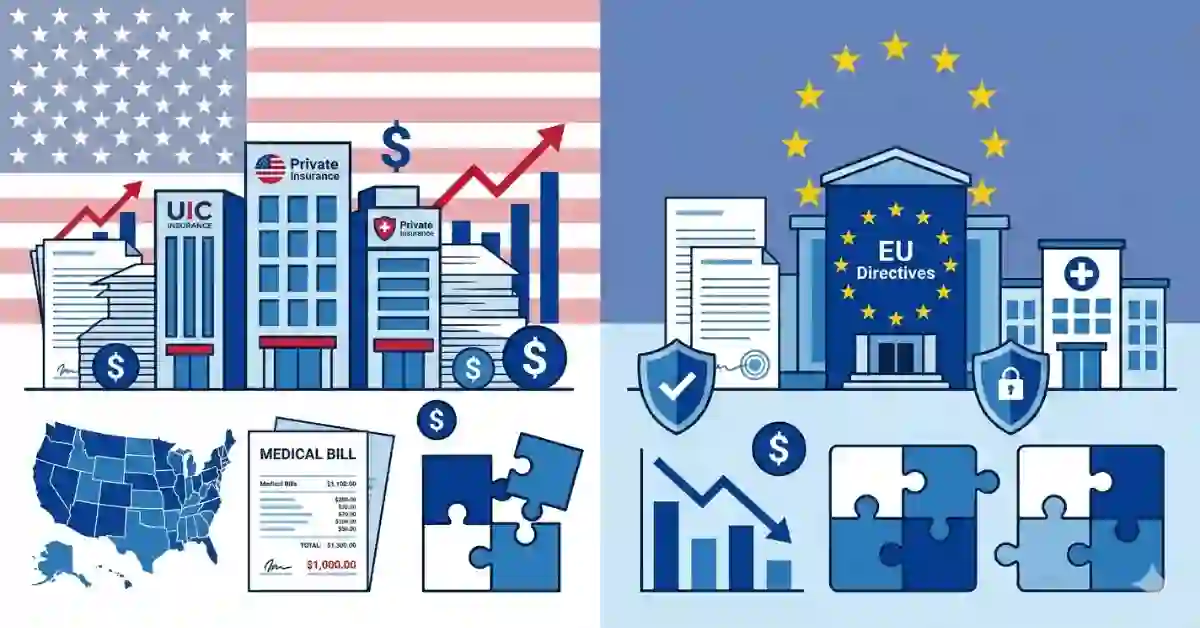
Insurance systems in the US and EU differ fundamentally due to regulatory structures, market dynamics, and societal approaches. The US has a decentralized, private-market-driven system regulated at the state level, leading to fragmentation and higher costs. The EU features more harmonized regulations (e.g., via EU Directives) with greater emphasis on consumer protection, universal access in some areas, and lower overall costs, influenced by public healthcare integration and stricter safety standards.
Key high-level differences:
- Regulation: US state-by-state vs. EU harmonized (e.g., Solvency II for solvency vs. US Risk-Based Capital).
- Costs: Generally higher in the US due to litigation, medical expenses, and profit-driven models.
- Coverage Focus: US emphasizes comprehensive private options; EU prioritizes mandatory minimums with optional add-ons.
- Cross-Border Validity: EU policies often valid across member states; US policies rarely cover abroad without extensions.
Detailed Comparison by Insurance Type (as of 2025)
| Insurance Type | United States | European Union | Key Differences / Notes |
|---|---|---|---|
| Auto / Motor | – State-regulated minimums vary (e.g., liability only in some; no-fault in others like NY, FL). – Premiums high (avg. $2,000–$3,000/year) due to litigation, medical costs, credit scoring. – Tort/no-fault mix; personal policies rarely cover abroad (only US/Canada typically). | – Harmonized EU minimum: Unlimited or high third-party liability (e.g., €5–7M+ for injury). – Bonus-malus systems common (discounts for no claims). – Premiums lower (often 30–50% less) due to universal health care reducing bodily injury claims, stricter safety regs. – Green Card for cross-border; valid across EU/EEA. | EU: More uniform, cheaper, higher mandatory limits. US: Fragmented, expensive, fault-based emphasis. Europeans often pay far less despite better protection. |
| Health | – Mostly private (employer-based or individual); public for elderly (Medicare), low-income (Medicaid). – ~8–10% uninsured; high costs ($12,000+ per capita spending). – No universal coverage. | – Universal public systems (single-payer like UK NHS or multi-payer like Germany/France). – Private supplements optional; ~100% coverage. – Lower costs ($4,000–$6,000 per capita); better outcomes (longer life expectancy). | Starkest divide: US private/market-driven (expensive, gaps); EU public/tax-funded (affordable, inclusive). US outcomes lag despite higher spend. |
| Homeowners / Property | – Standardized forms (HO-3 most common); covers dwelling, contents, liability, loss of use. – Often includes broad perils; flood/earthquake separate. – Required for mortgages; replacement cost common. | – Varies by country; buildings (structure) and contents often separate policies. – Mandatory in some (e.g., Germany for owners); covers fire, storm, water, but subsidence common inclusion. – Broader natural disaster exclusions; lower premiums. | US: Bundled, comprehensive, liability-focused. EU: Often split (building vs. household), simpler, cheaper; more national variations despite harmonization efforts. |
| Life | – Complex products (term, whole, universal); investment-linked common. – Highly competitive private market; central to retirement planning. – Larger market share globally. | – Simpler term/endowment policies; pure protection focus. – Less tied to investments; often bundled with pensions. – Regulated under Solvency II for guarantees. | US: Sophisticated, savings-oriented. EU: Basic protection; lower penetration as social safety nets reduce need. |
| Overall Regulation & Solvency | – State-level (NAIC coordinates); Risk-Based Capital (RBC) formula. – Fragmented; reinsurance collateral rules eased via US-EU Covered Agreement. | – EU-wide Solvency II (since 2016): 3 pillars (capital requirements, governance, disclosure). – Market-consistent, risk-sensitive; Prudent Person Principle for investments. | EU more principles-based/harmonized; US rules-based/state-varied. Solvency II seen as stricter/more modern than US RBC. |
Additional Insights
- Premium Costs & Claims: US claims inflated by lawsuits (“ambulance chasers”) and uncovered medical bills. EU benefits from public health systems and tort reforms.
- Consumer Protection: EU stronger on transparency/cross-border; US varies by state but offers more customization.
- Trends in 2025: Rising cyber/climate risks pushing premiums up globally, but EU’s unified approach aids resilience. US sees ongoing debates on health reform.
If you’re comparing for a specific country (e.g., Germany vs. California) or type (e.g., travel insurance validity), provide more details for a tailored breakdown!